LUMINOUS FOOTPRINTS
(The Christian impact on India)
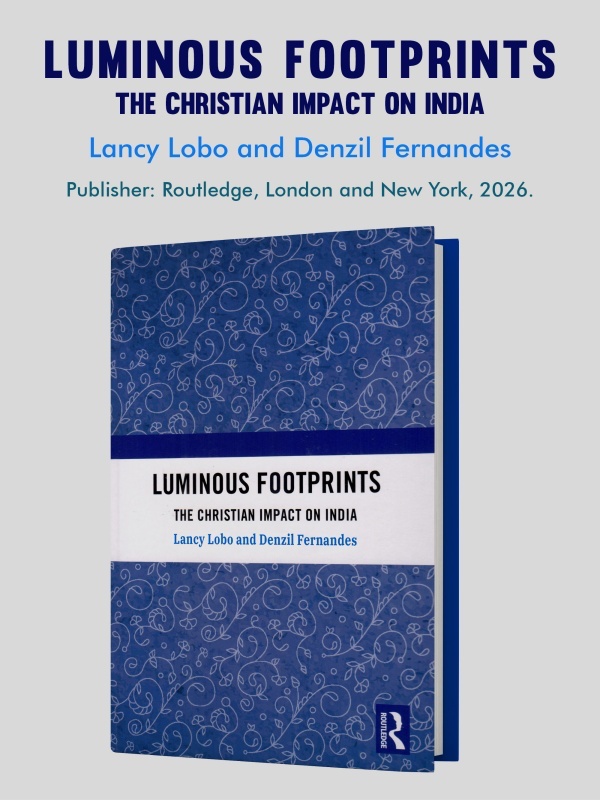
Authors: Lancy Lobo & Denzil Fernandes
Pages: 152 Hardcover, Price: Rs 1295/-
Published by: Routledge, Taylor & Francis, London & New York
Distributors: Atlantic Publishers & Distributors orders@atlanticbooks.com
This is a book by two redoubtable Jesuit scholars. Lobo is currently the Research Director of the Indian Social Institute, New Delhi, while Fernandes is its former Executive Director. Those familiar with the work of this Institute in the field of social services and research will find this a sufficient pedigree of the authors.
This book falls in the genre of previous works like “The Christian Community and the National Mainstream” by Prof Louis d’Silva of Bombay University and “The Catholic Community in India” by Ka Na Subramaniam. Yet each contribution to this vast subject is a unique and Herculean effort in itself.
In the authors’ own words, in today’s vitiated socio-religious atmosphere “this volume is a humble attempt to bring to the notice of men and women of goodwill in mainstream society, the significant contributions of Christians to India … It is an evidence based exposition of the Christian contribution to modern India’s socio cultural, economic and political life, not only for academics but also for ordinary readers”. Let’s get this straight; if this is a book by academics for fellow academics, it is par excellance. It should find a place in libraries and all institutions of higher social or religious learning. As for the “ordinary reader” I will revert to that later.
This research work is divided into somewhat familiar heads: 1. Introduction to Christianity in India 2. Education 3. Health & Social Welfare 4. Scientific & Economic Development 5. Political, Administrative and Professional Services 6. Language, Literature & Art 7. Christian Encounter with other Religions.
Since areas like education and healthcare are well documented and commonly accepted I will not dwell much on them. One thing that stands out is that other than the Catholic bastion of Goa from the 16th Century, for the rest of India, the pioneers in these fields were mostly foreign missionaries from the Anglican Communion.
Among Indians are Pandita Ramabai Saraswati (1858 – 1923) who became a Christian in 1883. However, in Maharashtra where she worked, the public perception of her is that of a social reformer, not a Christian activist. Sadly, perception over rides factual evidence. A more contemporary name is that of Padmashri Thomas Kunnunkal SJ, who passed away very recently. To him goes the credit for the Central Board of Secondary Education (CBSE) and the National Open School system.
In healthcare too we find that non-Catholic missionaries were in the vanguard; like Clara Swain in Bareilly (1877), Edith Brown at Ludhiana (1894) and Ida Scudder in Vellore (1900). Could it be, that given the limited missiology of the times, Catholics were more concerned with saving souls than healing bodies? From the book we learn that the first successful open heart surgery (1961), first kidney transplant (1971) and first bone marrow transplant (1986) can be attributed to Christian health services.
In the area of scientific development (the Galileo hiccup notwithstanding) Christians contributed immensely to scientific development in India. Joseph Tieffenthaler SJ (1710 – 1785) was a leading geographer. The most famous case is the contribution to our space programme. It was the small church of St Mary Magdalene in Thumba (Trivandrum) that gave up its land under the visionary leadership of Bp Peter Pereira, to Drs Vikram Sarabai and APJ Abdul Kalam, for the country’s first space rocket to be launched from there in 1963.
How can one forget the visionary contribution of Padmabhushan Dr Verghese Kurien (1921 – 2012) the father of the White Revolution that made India the world number one in milk production (approximately 25% of global production)?
Of special interest also is the Christian contribution to the Independence movement. Here again, ironically, Anglican foreign missionaries were in the forefront; led by Deenabandhu C.F. Andrews (1871 – 1940), Stanley Jones and Verrier Edwin. Thevarthundiyil Titus was one of the 70 marchers in Mahatma Gandhi’s famous Dandi March. Several Bengali Christians like W.C. Banerji and H.C. Mukherjee were also active in the Congress. In the 1887 Madras meeting of the Indian National Congress, 35 of the 607 delegates (6%) were Christian, again higher than the actual Christian population.
In today’s super charged era of ultra-nationalism the singular contribution of Christians to the Defence Services deserved more space than the two paragraphs in the book. We have had two Defence Ministers, 6 Chiefs of Staff, one Paramvir Chakra, several Mahavir Chakras and other gallantry and distinguished service awards.
As a critic I need to also draw attention to some of the shortcomings of this book. The choice of title and the unimaginative cover page are wanting. The book is over priced. Institutions and libraries could afford it, but not the average inquisitive (not argumentative) Indian. As I said at the beginning, this fact filled tome is excellent for academicians, but this very approach makes the narrative too dry for the average reader.
Minor hiccups apart, I would fully endorse this book as a valuable addition to Indian Christian literature; as a reliable and authentic resource book. Our gratitude to the authors for their meticulous research, a true labour of love


Leave a Reply to James Pochury Cancel reply