On Good Friday I ask myself, was Jesus a missionary or a revolutionary? Blessed Rani Maria of the Franciscan Clarist Congregation (FCC) faced a similar dilemma when she began her service to the deprived adivasis in the Udaynagar region of Indore, M.P. This is a dangerous binary. Being a missionary and/ or a revolutionary are not mutually exclusive. To the contrary, they are two sides of the same coin.
Two days ago I was invited to watch the movie “The Face of the Faceless” on the life and martyrdom of Sr Rani and write a review. Had it not been for the invitation I may not have gone, because of my pre-conceived notion that it was the usual pious propaganda. How wrong I was.
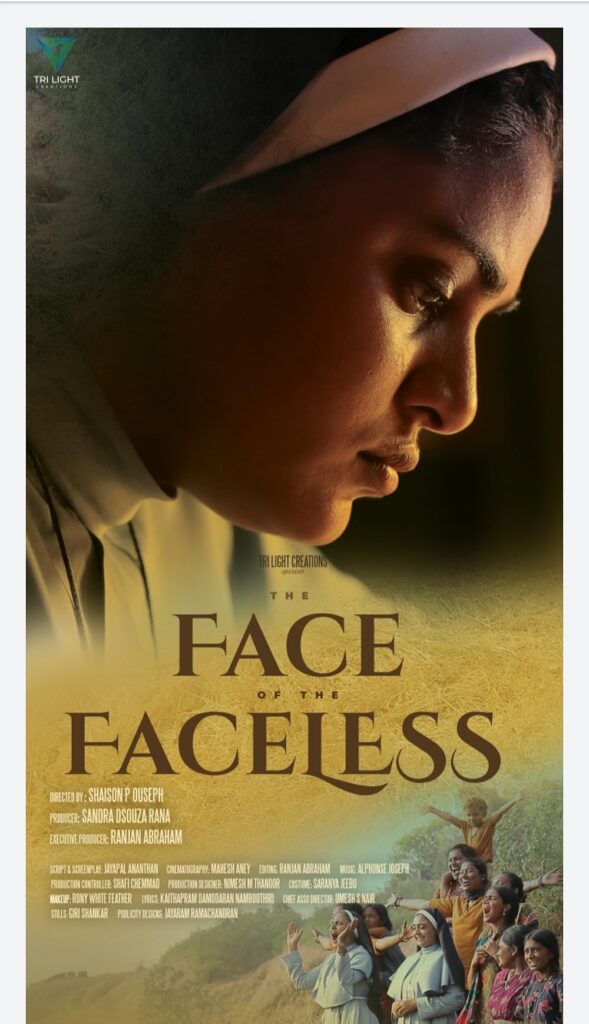
First the facts. This two-hour movie has been directed by Dr Shaison Ouseph and produced by Sandra D’souza Rana. The lead role of Sr Rani is played by Malayalam actress Vincy Aloshious with a cast of 150 from 16 States of India, a record in itself. It was 7 years in the making, cost Rupees Ten Crores and is a recipient of 125 awards, including the Baba Saheb Phalke Award. It has now been nominated for the Oscars in the “Sound & Background Score” category. It is in Hindi with some dialogues in Malayalam and English subtitles. The movie is now being shown to select audiences by Yesuraja, a Salesian lay missionary. That’s the bare facts.
I found the movie touching and disturbing, forcing me to reflect on several related issues. The storyline is about Sr Rani being appointed the superior of the convent in a remote tribal area of Indore. Almost immediately she is confronted with violence, injustice and oppression of the adivasis by the ruling strongman and his henchmen. It begins with two tribal women clandestinely (or so they thought) filling water from the village well. The henchmen thrash the women and smash their earthen pitchers. Sr Rani, welcome to rural India where might is right.
Sr Rani, her baptismal name was Mary Kunju, was a native of Kerala where her family opposed her joining the FCC congregation. This was started on 14/12/1888 by the French Jesuit Bp Charles Lavigne, the Vicar Apostolic of Kottayam. It moved to “mission” territories outside Kerala in the 1960’s. It now has 7000 members.
In the next scene we see those same women draining dirty water from a shallow pond frequented by dogs. Next we see a pregnant woman who has no access to modern medical facilities. Then we find a leprosy patient outcast by the village. Sr Rani reaches out to him also.
Seeing their plight Sr Rani begins knocking at various doors – the Primary Health Centre, a Malayali doctor from the neighbouring town of Dewas, and even a bank manager. She meets with little success. She then starts a self-help group, starts a school, digs a well, starts tilling the land and producing vegetables.
Now the double whammy. The strongman burns down the school and standing crops, pollutes the well with diesel and snatches away all their farm produce. This could be a familiar pattern across rural India – the exploitation, rape and murder of the powerless. Sr Rani becomes the voice of the voiceless, the face of the faceless. I saw shades of the blockbuster movies Sholay and Lagaan in those scenes. Except that this was real not reel life.
Jesus had said that he had not come to bring peace but the sword of division, setting one up against the other (cf Lk 12:51). This now happens in Rani’s community too. Some sisters are not happy with her rocking the boat. The provincial tells her to “abide by the rules” and be a missionary not a revolutionary. Things were beginning to turn full circle.
In the midst of all this she is informed that her younger sister Selvi, also in the same congregation, is afflicted with cancer. When she decided to go visit her, the villagers plead with her not to abandon them. Her coming had made them human and given them courage. This was more than the strongman could stomach. He goes to the convent with his double barrel 12 bore gun and German Shepherd dog, while smoking a Havana style cigar. Sr Rani, somewhat naively, tells him that God loves him and so do they. She offers him a glass of tea. He takes it but melodramatically pours it out for his dog to drink. It was not a subtle message.
Rani now boards a bus to go home. Enroute a man gets in. Further down he stops the bus at a roadside shrine, breaks a coconut in offering and reboards the bus. He takes out a knife to serve the coconut kernel which Sr Rani unsuspectingly accepts. He then stabs her to death. She becomes a martyr for social justice.
Saminder, the assassin gets a jail term. Sr Selvi visits him there and ties a rakhi on his wrist. She then takes him to meet their mother in Kerala. End of story. Now my reflection begins.
Rani is constantly referred to as Motherji, an honorific jettisoned by Vatican II. She receives communion on the tongue, again an aberration. The priest who mentors her wears saffron robes that gel with his snow white hair and beard. But how many Catholic priests look like that?
Speaking in Malayalam to lend a degree of authenticity is fine, but it was a bit overdone. In almost 60 years of public life I have never seen sisters in habits doing back breaking manual labour, as distinct from convent gardens. So was this reality or a mirage?
I also find it odd that a Syro-Malabar congregation has two Italians as its patrons Francis and Clare of Assisi and that they continue to wear medieval European habits, while most other congregations have switched to sarees. But there’s a caveat. I have seen these sisters serving the poor and disadvantaged in far flung areas in North India. Though comparisons are considered odious, I have no hesitation in saying that they come across as having more zeal and dedication than many other more sophisticated congregations of European origin.
If there is one aspect of the story that I find hard to swallow it’s the contrition of the assassin Saminder. He gets a remission of his life sentence for good behaviour especially after Sr Selvi ties the rakhi. I discussed this point with Yesuraja.
Saminder never revealed who had hired him to kill Sr Rani. The strongman and his henchmen were neither indicted nor punished. Saminder now lives in the same village but is scorned by society. Of late he said that Sr Rani has been glorified because of his actions, so he too should get a part of the spoils! I am not surprised, because long before I saw the movie I was never convinced of his contrition.
Take Mehmet Ali Agca, who attempted to assassinate Pope John Paul II. The latter visited him in jail and forgave him; but he didn’t get any remission of his sentence. Closer home Priyanka Gandhi visited Nalini who was a conspirator in the assassination of her father Rajive. She too got no legal reprieve. This makes Saminder’s case more curious.
What of Sr Valsa SCJM, also stabbed to death, in Jharkhand, for standing up for the poor adivasis. Coincidentally, she too had gone to Kerala to visit her cancer stricken brother. She was assassinated a couple of days after her return. Interestingly, Valsa’s congregation, of Belgian origin, did not see her as a martyr, perhaps because she had not “abided by the rules”. There are many other RTI activists, journalists and trade unionists who have sacrificed their lives for the causes that they had espoused. There was even an officer of a petroleum company who was killed because he had exposed mass adulteration.
I’m sure that many who saw the movie would have been moved to tears. It reminds me of what Jesus said to the women of Jerusalem on Good Friday; “Weep not for me, but for yourselves and your children” (Lk 23:38).
Let me end on a positive note. I hope and pray that those who watch this movie may be inspired to exercise a preferential option for the poor and speak up against injustice – be they priests, religious, journalists or trade unionists.
One may have to pay a price, but don’t shy away. Start small, start now – by being just and honest in all your dealings and relationships, be they with one’s spouse, family, co-workers, employees etc.
This brings me back to my first question – being missionaries or revolutionaries? Sadly, some of us, living in elite institutions behind high walls, may have become machineries instead; just churning out statistical data, seldom touching peoples’ lives. I conclude with the wisdom of Dom Helder Camara, archbishop of Olinda and Recife in Brazil, the source of liberation theology. He had observed that “When I feed the poor they call me a Christian. When I ask why they are poor, they call me a Marxist”!


Leave a Reply