BOOK REVIEW
“Christians in India -The Nations Vital Asset” edited by Dr. Louis D’silva, Published by St.Paul’s Publications, Mumbai, hardcover, 965 pages, price Rs 700/- available at sales@stpaulsbyb.com, phone 9969403426.
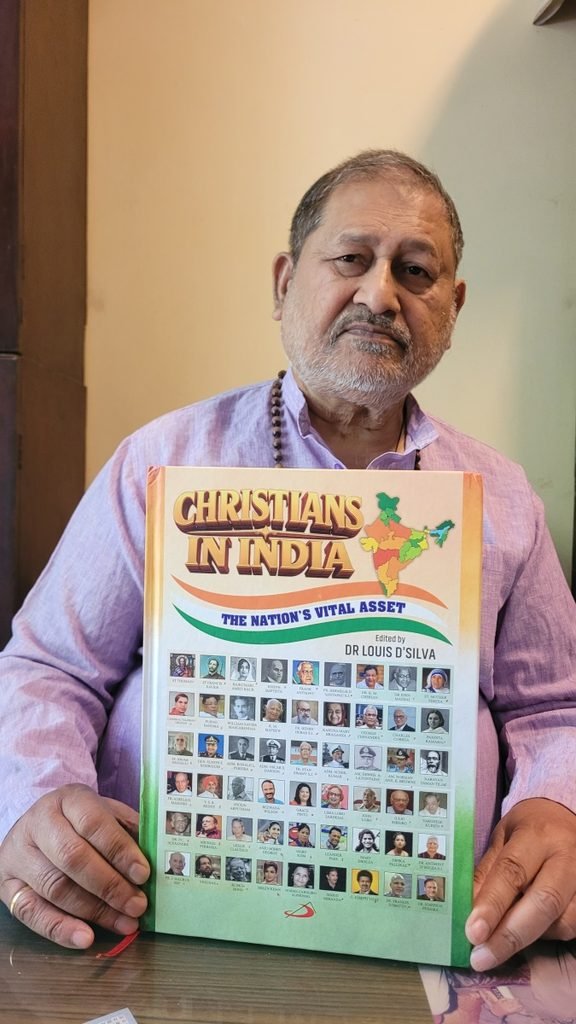
The Christian community in India should be eternally grateful to Dr. Louis D’Silva, former associate professor, University of Mumbai for editing this voluminous tome. It is a continuation of his earlier book, “The Christian Community and The National Mainstream”, published in 1985. I have received and reviewed several books on this subject, but D’Silva’s work is in a class of its own. Contributing editors include Virginia Saldanha, Rev. Fr P.D. Mathew SJ, Maj Gen. Eustace D’souza, Ignatius Dabhi, Bp. Allwyn D’Silva and Prof. Anthony Kunnath.
This encyclopedia (calling it a book would be a disservice) is divided into 5 major sections:
1. Historical services.
2. Vital Services like education and health.
3. Multifarious services like history, sport, music etc.
4. Basic services like civic, political life and defense.
5. Realities and reflections including a vision for the future.
These major areas are sub-divided into 41 chapters. Why should anyone embark on such a mammoth task? The answer is found in the foreword by Cardinal Oswald Gracias, Archbishop Emiretus of Mumbai, and in the author’s own introduction. I quote: “In these pages you will discover the heroic figures who have carried the torch of Christianity throughout India’s history, from the arrival of St. Thomas” (Gracias Pg 9).
D’Silva’s introduction is even more telling: “It is necessary to dispel certain misconceptions about Christianity and Christians in India, some of which are widespread and deep-seated. The first misconception is that Christianity is a Western or European Religion.” (pg 11). This is the crux of the matter. D’Silva debunks these misconceptions, not with the words of Christian scholars, but with the observations of renowned statesmen like President Dr. S Radhakrishnan and Prime Minister Jawaharlal Nehru.
Nehru said, “Christianity is as old in India as Christianity itself. Christianity found its roots in India before it went to countries like England, Portugal and Spain.” This statement was made in the Lok Sabha on 3/12/1955 (pg 11). It counters the misconception that British or Portuguese colonialists brought Christianity to India. Another interesting quote is from Nehru’s epic, ‘The Discovery of India’. “Jainism and Buddhism had largely faded away and been absorbed by Hinduism.” Christianity did not meet the same fate, perhaps because of the “vitality” of the Christians whose lives and contribution to the country are painstakingly recorded in this book.
While there is no disputing the mention of the great saints like, Thomas, Francis Xavier and Mother Teresa, there are personae that could be questioned. Take Raja Ram Mohan Roy (pg 47). It states that he “rejected Christian doctrines like the Trinity, Incarnation and the Divinity of Christ” (ibid). That being so he cannot be classified as a “Christian”. His admiration of Christ is not a determining factor. Mahatma Gandhi also had great admiration for Jesus, and many feel that he was a better Christian than us. We still cannot classify him as a “Christian”.
Another controversial entry is that of Pandita Ramabai (pg 59). She was purportedly baptized in England in 1883, but it is questionable if she subsequently lived according to the Christian faith. Many non-Christians could challenge our appropriation of Pandita Ramabai as a Christian.
Harish Salve (pg 671), under the category of lawyers and judges, is described as one of the most expensive lawyers in the world. He is not known to profess the Christian faith and some of the issues that he has espoused, including on TV debates, could hardly classify him as a Christian.
There are others, who may have publicly professed to be atheists or agnostics, but lived exemplary Christian lives, based on values of truth and justice. Among them are the former Chief Election Commissioner, James Michael Lyngdoh (pg 810), Supreme Court criminal lawyer Colin Gonsalves (pg 668) and former Defence Minister George Fernandes (pg 703).
The last often chose to distance himself from the Christian community. As National President of All India Catholic Union (AICU) in 1990, thanks to my predecessor in office, George Menezes, we met him regarding the rape of nuns in Gajraula. His first response was, “Why do you protest only when nuns are raped?” Subsequently he did visit Gajraula with our Vice President Paul Mantosh MP. However, the Christian community could never forgive him for not speaking up against the gruesome murder of Rev Graham Staines and his two minor children.
The section that I like most is that of our contribution to the armed forces (pgs 848-865). Other than two defense ministers we have had 6 Chiefs of Staff – 3 in the Navy, 2 in the Air Force and 1 in the Army. The very first Mahavir Chakra was awarded to Sqn Ldr. Sidney Noronha (posthumous) for the 1947 ops. Of the 16 Param Vir Chakra awardees, one is a Christian, Lance Naik Albert Ekka. This is just a peak into a rich treasury. Perhaps, it is the best response to those who dare to question our loyalty to the nation. However, this section, by Maj Gen Eustace D’souza, is almost ad verbatim of what was published in 1985, though it doesn’t detract from the reality.
This tome weighs 2.25 kg and is printed in A4 size. The font size is also quite large. Had it been smaller, it would have reduced the number of pages. The paper quality is substandard, it should have had a higher GSM. Though that may have made it even heavier.
There are a few more minus points. The alphabetical index uses first names, not the usual surnames. If one is looking for the Amritraj brothers, one would have to look for Vijay under V, and his brother Anand under A. It would have been so much easier for researchers if all the Fernandes, or Vergheses were clubbed together. One section that I found incongruous was about Goan officers in the armed forces (pgs 859-864). This goes against the grain of a ‘national’ contribution.
I also noticed some factual errors. The biggest blooper is where the author states that Christianity, with 2 billion followers, is the second largest in the world (Pg 11). It is in fact the largest, with Islam following close behind. Mahatma Gandhi’s dentist is called Dr. Christopher Barretto (pg 800). His actual name was Christovan. Dr. Remy Denis (pg 627) is shown as born in Gorakhpur. No doubt he worked there, but he was born in Ballia district.
On a personal note, I was pleasantly surprised to find my photo on the Back Cover and a full page devoted to me. Five past National Presidents of the AICU are covered: 1. Chevalier Mariadas Ruthnaswamy (pg 117), a member of the Constituent Assembly and founder of the organization.
2. George Menezes (pg 741), described as an eminent writer, inspirational speaker, divergent thinker and delightful humorist. 3. I join him in the section of “extra ordinary lives” (pgs 753-754) as “one who has lived a highly active and socially oriented life”. 4. Dr. John Dayal (pg 458) under the section of Journalists and Activists is “fighting for the rights of Muslim, Christian and Dalit minorities”. 5. Dr. Remy Dennis (pg 627) under scholars and scientists is a “PhD and DSc in mathematics with over 900 published research papers”.
All said and done, Louis D’Silva’s work is a labour of love and a huge contribution to contemporary Christian literature. He deserves our thanks and prayers. One must also appreciate St. Paul’s Publications for bringing out this huge volume at a very low price of just Rs. 700/-. It is worth every paisa. This book should find a place in every library, Christian institution and on the book shelves of Christian activists and leaders. May the reading of this book vitalize all of us.


Leave a Reply