Synodality (yawn), one would have thought that it was dead and buried with Pope Francis. It’s quite probable that there are many in the church, mostly from among the clergy and hierarchy, who would be happy if that were so. They were distinctly uncomfortable with Synodality and just paid lip service to it.
What is Synodality? It means walking together, in which one is joined by the Lord, as on the road to Emmaus, when the disciples’ hearts burned with fire, and they recognized the Risen Lord. Pope Francis gave it a new meaning, that of communion, participation and mission. The sticking point is participation. Those in power are loathe to let go, hence the resistance to Synodality.
It was for this reason that the Indian Catholic Forum organized a discernment meeting on a Synodal Church and Secular Society, held on 11th /12th October at the Cardinal Parecattil Renewal Centre, Kochi, Kerala. It was addressed by an array of learned speakers, with 38 participants from across the country.
Rev Dr Kuruvilla Pandikattu SJ former professor at the Papal Seminary, Pune and XLRI, Jamshedpur, presented the keynote address on “Synodality – Obstacles and Opportunities”. He began by asking – Walking Together, but where to? Who is allowed to walk, who chooses the road, who is heard along the way, who is left behind?
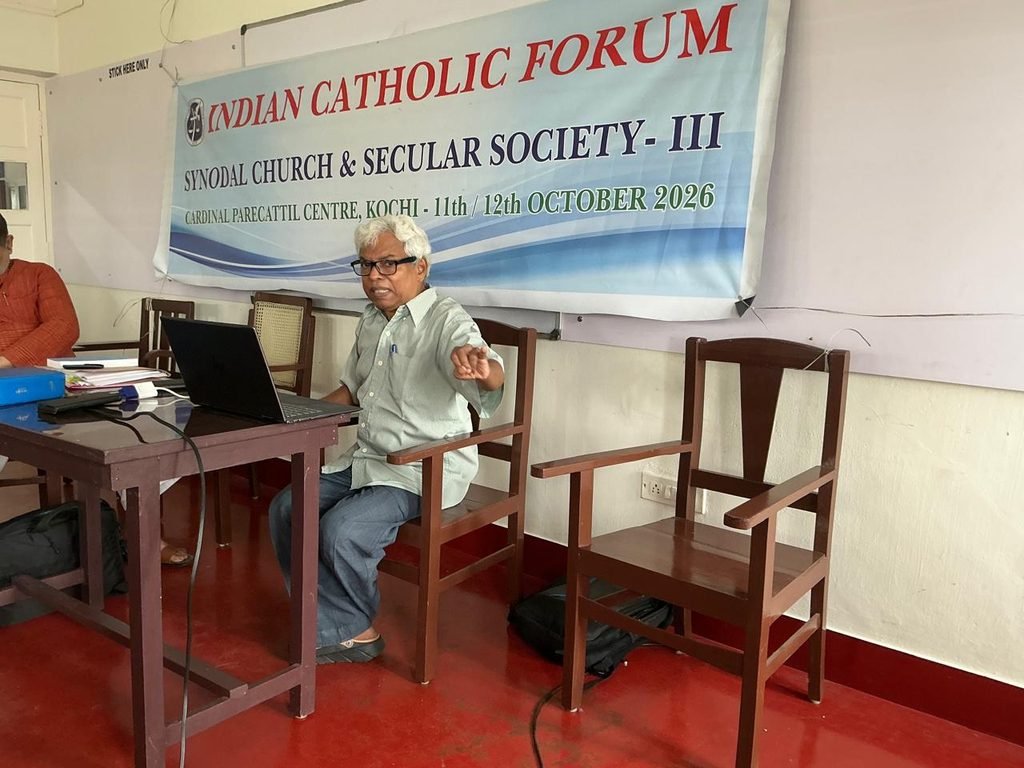
Synodality is not simply an invitation to hold meetings. At its deepest level it concerns the devolution of power. It is not just an appealing ecclesiastical slogan but a radical renewal of Christian life in which authority serves, truth is shared, differences are respected and the vulnerable genuinely participate. In the renewal of the church “tradition” should not become a weapon by which yesterday silences today.
The biggest obstacle to Synodality is clericalism, said Kuruvilla. Vatican II had already restored the theological priority of the People of God, though baptism. Yet many
Parish Councils remain largely decorative; Finance Committees sometimes learn about decisions only after they have already been made. Lay persons find that their competence counts for very little while the clergy retain control.
Synodality cannot be achieved without historical honesty, listening patiently, mediation and the willingness to distinguish between what is essential and what is just customary. Sadly avoiding scandal may appear more urgent than justice. The credibility of an institution is destroyed when wrongdoing is concealed.
Existing ecclesial structures tend to treat even lay leaders as volunteers or donors. But they are not assistants to the clergy. They are co-responsible members of the People of God, because though ordination may confer sacramental responsibility it does not automatically confer universal technical expertise.
Good journalism also performs a public synodal function as it listens to different voices, investigates competing claims and verifies evidence. .We cannot invoke press freedom when Christians suffer discrimination but resent it when journalists investigate Catholic institutions. A synodal church should therefore promote media literacy and independent journalism.
Ultimately every diocese should do a periodic synodal audit.. Who speaks, who decides, who benefits and who is missing. Synodality asks for conversion from ceremonial consultation to shared responsibility, secrecy to accountability, male predominance to partnership, from speaking to the marginalized to walking with them. A tall task. Small wonder that those in power shun Synodality.
The next keynote speaker on “Ecumenism and Synodality” was Rev Dr Sunil Caleb Rector of Bishops College (CNI) Kolkata. He made a pertinent observation that when Ecumenism begins at grassroots level with the laity the church leadership is pushed to also collaborate. The Ecumenical movement, he said, has always been synodal. Unless Churches are willing to walk together, they cannot make ecumenical progress, He gave a historical account of how ecumenism evolved in various churches based on the Lord’s call to unity (cf Jn17:21)
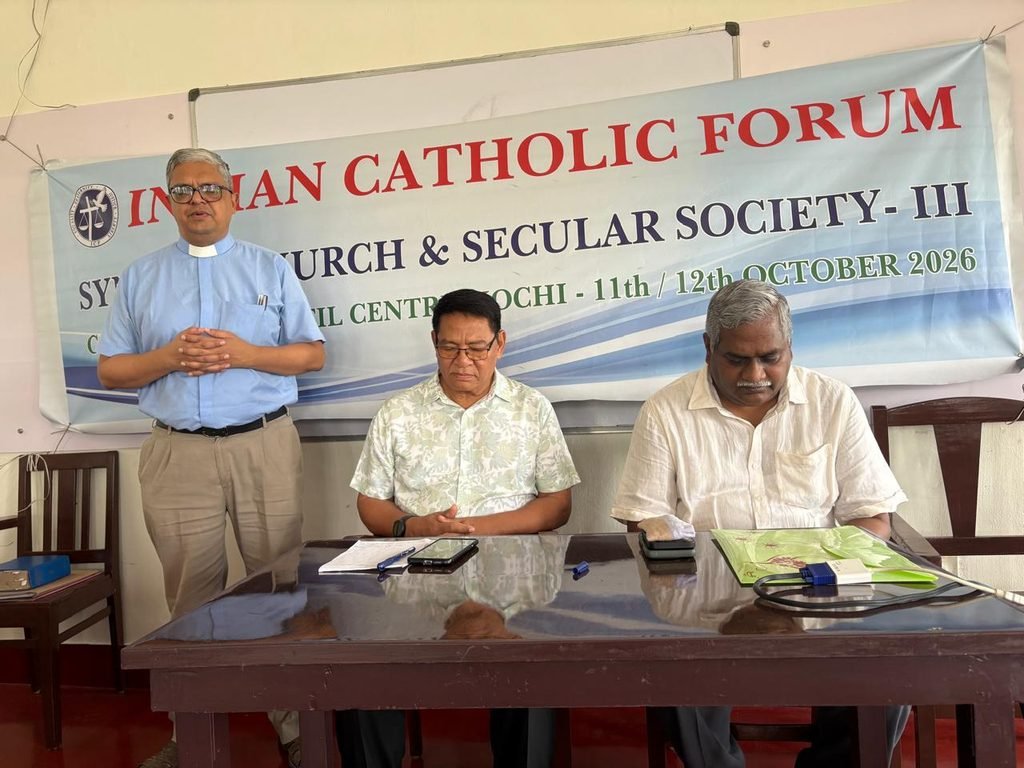
An important step in this direction has been the acceptance of baptism “which unites us to Christ and faith”, as the basis of unity. The Catholic Church’s teachings in Lumen Gentium echo this sentiment. Synodality offers hope for the future of ecumenism by fostering habits of listening, humility and shared discernment.
Secular lay leadership is also a critical component of Synodality. The mistake that many lay leaders make is to seek office within church structures instead of standing up and proving themselves in the outside world. Three leaders shared their experiences of lay leadership in the fields of business, government service and social action.
Blaise Costabir, an industrialist from Goa, said that most Catholics are job seekers instead of being job creators. The challenge is to influence society and the Church through one’s own competence. After his encounter with Jesus in 2013 his value system changed, including zero tolerance of bribery and corruption.
Dr Kuruvilla Thomas IFS (Retd) was a senior bureaucrat. Because of his honesty he had been transferred more than 30 times, but it did not break his spirit. He said that true leadership is in serving others. We should let our light shine. We should also listen to the poor and ensure that social benefits went to the deserving. One can always draw inspiration from the Bible he said.
Mathew Mathai, a social activist shared his experience during the Kerala floods of 2018 when he had organized 70,000 bags of relief materials. He also shared his experience of promoting Panchayati Raj and the establishment of happy Villages.
chhotebhai dwelt on the faith formation of youth. He said that there was a big gap between Confirmation and Marriage Preparation, both of which were perceived more as statutory/sacramental obligations than true faith formation. Youth faced crises situations when they left the comparative shelter of school and home to pursue higher studies or careers. It is at this stage of critical awareness that they often fall away or become lukewarm towards the faith. It was important to reach out to them in a cogent and rational manner.
Dr S. John Bosco, a disciple of the late Swami Amalorpavadas, touched on the sensitive issue of Women and Married Clergy. He queried why the masculinity of Jesus was the determining factor of the sacramental priesthood. From the beginning the Bible presents humanity as a united creation of both genders. During his lifetime Jesus reached out to women as equals. Ordination of women is not a struggle for power or authority but a question of human dignity. Tradition is not a frozen monument of the past. It is a living transmission of the apostolic experience. The Church distinguishes between “unchangeable truths” and “changeable disciplinary practices”. Ordination of women and married persons falls in the latter category.
The second part of the discernment programme was on Secularism. A.C. Michael, former member of the Delhi Minorities Co0mmission, was the keynote speaker on “Is Secularism Dead?” It wasn’t, as the vast majority of our countrymen still believe in it. This, despite the current regime, that is inimical to the State having no official religion and treating all religions equally. The so-called Freedom of Religion Acts are a direct assault on secularism. They even encroach on the privacy of individuals in inter-faith marriages. Increasing communal polarization, identity politics and intolerance towards Minorities can contribute to an atmosphere in which Christians and other Minorities become vulnerable to discrimination and hostility.
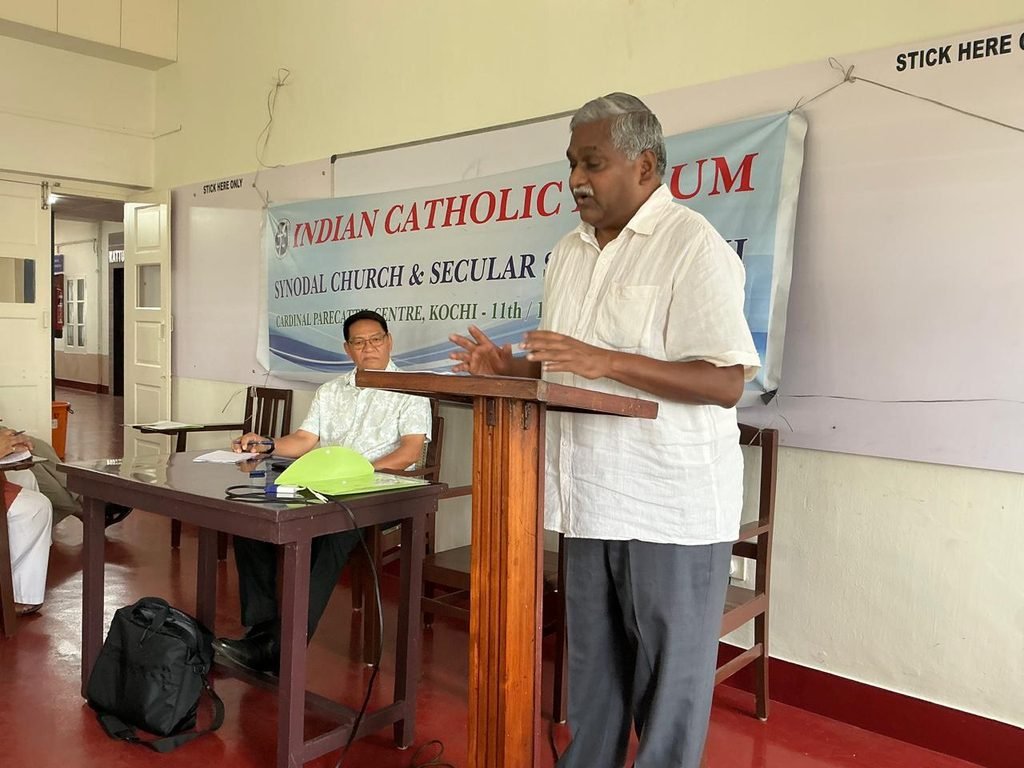
Sushil George, Director Sui Juris, Indore, shared more details of the anti-conversion laws. The problem is not so much with the Catholic and other mainline Churches but fron the mushrooming House Churches, especially those funded by foreign agencies. Such agencies tend to take up bail cases in the higher courts but don’t give due importance to trial courts where cross examination is critical. This could eventually lead to thousands of cases pending in the trial courts.
Mumbai based linguist and historian Dr Babu Verghese chose a counter narrative. Sri A.B. Vajpayee, former BJP Prime Minister, had once alleged that foreign missionaries were responsible for the destruction of Indian culture. Nothing could be further from the truth. Focusing on Christian missionaries’ contribution to the development of Indian languages he first gave the instance of Padmabhushan Dr Camille Bulcke SJ, whose English Hindi dictionary is a classic. Other than that Christian missionaries developed 85 dictionaries, 116 grammar books and 45 newspapers/ journals. His research showed that an American Presbyterian missionary in Allahabad, Rev Samuel Kellog (1839-99) was the Father of modern Hindi. It is important to nail the false propaganda of today.
David Lobo of Bangalore threw light on the much debated amendments to the FCRA, that many Christians perceive as being a not so subtle attack on Christian services and properties. While on the one hand transparency and compliance are to be welcomed, on the other hand there is a big trust deficit. Of particular concern are the immense powers vested in the proposed “designated authority” that include the takeover of immoveable assets acquired through foreign funding. Every threat is also an opportunity. In this case it is to be less reliant on foreign funding and develop one’s own local funding. There is no dearth of resources within the country itself.
Rev Sunil Rozario, former editor of The Herald, Kolkata, spoke of the Media as an Influencer, both good and bad. India had about 1.03 billion internet users and 500 million active social media users, 34% of the total population. We need to cater to them. Sadly, in 2019 the Press Freedom Index released by Reporters without borders ranked India as low as 140 out of 180 countries.
He further observed that when media houses become too closely aligned with political or corporate interests, their ability to question authority weakens and the public’s trust is eroded. This is what is happening in our country.
John Shilshi IPS (Retd) of the Manipur cadre shared his firsthand experience of why Manipur is burning for the last three years. It is important to understand the pain of the local populace. The problem is largely of the making of the ruling politicians. Unfortunately many outside journalists are like parachutists dropping by and preparing shallow and biased “ground” reports.
Swami Sachidanada, a former IAF officer, turned sanyasi affirmed that Inculturation was the antidote to Conversions. We need to move beyond Jewish, Roman, Greek, Colonial and Commercial forms of Christianity to evolve our own Indian Christian ecclesiology, missiology, spirituality and Christology.
(This is a synopsis of the papers presented. The final report follows. Pics by Cornelius Kujur. The writer is the Convenor of the Indian Catholic Forum).


Leave a Reply