In 1911 the English poet W.H. Davies wrote the poem “Leisure”. Its famous opening lines are:
“What is this life if full of care
We have not time to stand and stare.
No time to stand beneath the boughs
And stare as long as sheep and cows”?
Taking a cue from him we went for a three day family break to the Pilibhit Tiger Reserve in the Terai belt of U.P., not far from the Nepal border. The Terai is a strip of dense forest in the Himalayan foothills that stretches from Uttarakhand in the west to Assam in the North East. In 1947, post Partition, vast tracts of the Terai region were given to refugees from erstwhile West Punjab. They felled the forests and established huge farms in the rich arable soil – producing vast crops of wheat, sugarcane, basmati rice and mint. Pilibhit is no different, a mini Punjab.
We are a family of nature lovers and bird watchers. So given the time and the money the first choice for a vacation is the forest. We had already covered most of the reserve forests like Corbett, Dudhwa and Katarniaghat. Now Pilibhit beckoned. It was an 8 hour, 325 kms drive from our hometown Kanpur.
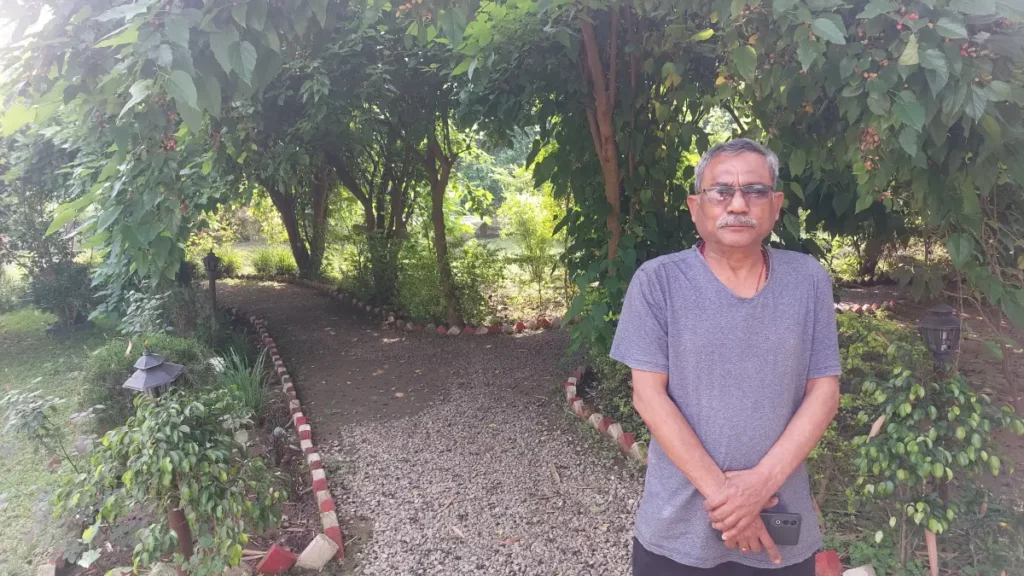
We normally stay in accommodation provided by the Forest Department, deep in the forest itself. However, possibly because it was a weekend that included Eid, we could not get that. Our daughter Mariam searched for alternatives on the net and zeroed in on a place called Earth Homes, just 300 metres from the entrance gate of the forest. We booked tents that were a far cry from what we imagine canvass tents to be. These had all modern amenities like geysers, AC and Wifi, while still retaining their rustic look.
Anil Sah, the owner of the resort, is himself a retired forest officer, so he used his native skills to make something nature identical. He had planted arcades or boulevards of mulberry trees. Since it was the fruit season the trees were laden with mulberries, thereby attracting hordes of birds. The pick among them was the the rare Indian Pied Hornbill, anthracocerous malabaricus.
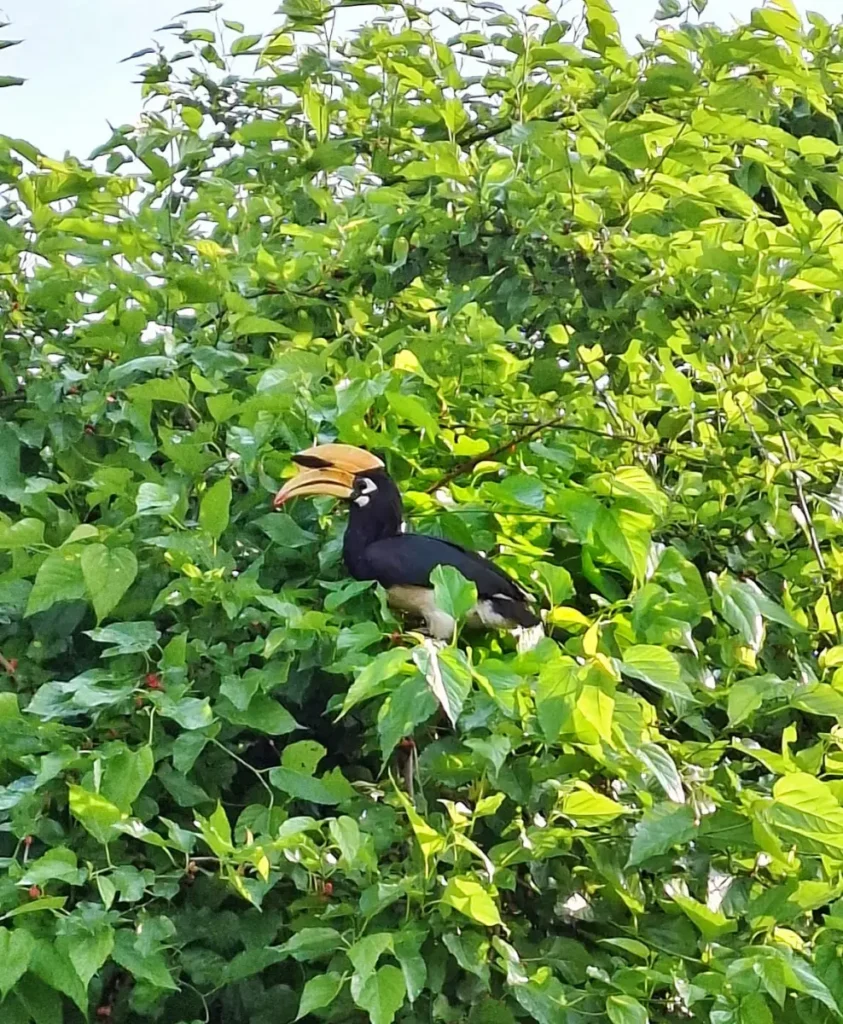
Among the birds, other than the multitudes of peacocks prancing and dancing in the middle of the jungle tracts, we saw the Crested Serpent Eagle, spilornis cheela, the Large Cormorant, phalacrocorax carbo, flocks of glossy ibis, plegadis falcinellus, the Emerald Dove, chalcophops indica, Red Jungle Fowl, gallus gallus, and a bird that had intrigued me for years. I knew that it belonged to the cuckoo family, but I didn’t know which one. It calls out in an increasingly high crescendo during the summer months. It is heard but seldom seen. Even our forest guide could not identify it. So he recorded its call on his phone and fed it into an app. Hey presto, we had the answer – the Common Hawk Cuckoo or brain fever bird, cuculus varius. What a joy when modern technology complements nature.
Back to the Red Jungle Fowl. The male had a crimson red plumage and a scimitar shaped yellow tail. In contrast the hens were a dull grey and in the ratio of 1:4. Was this the origin of polygamy where the male fell in battle or while hunting causing a gender disbalance? That’s no longer valid, with women today being smarter and higher earners than men. Besides how much strength does one need to press a button to launch a missile or a drone? The days of Tubal Cain, the man of might in the days when the earth was young, are long gone.
At Corbett we had spotted a tiger and were charged by an elephant. Deer and other wildlife were aplenty. Dudhwa is known for its rhinos but we didn’t get to see any. We did see an elephant in Katarniaghat, but not the river dolphins that it is known for. Yes, we had seen herds of abandoned cattle, thanks to the U.P. government’s myopic policies.
Would we get to see the elusive tiger in Pilibhit? When expectations run high disappointment is sure to follow. We could verily be missing the wood for the trees. So we were realistic; enjoy the moment and be thankful for what you get to see.
We saw herds of spotted deer (chital), some swamp deer and some bluebull (nilgai) that, despite its misnomer, belongs to the antelope family. Because they destroy standing crops they are classified as vermin, and may be culled in certain circumstances. To avoid misunderstandings, as a consequence of the misnomer, the U.P. Government has now renamed it as Vanroz.
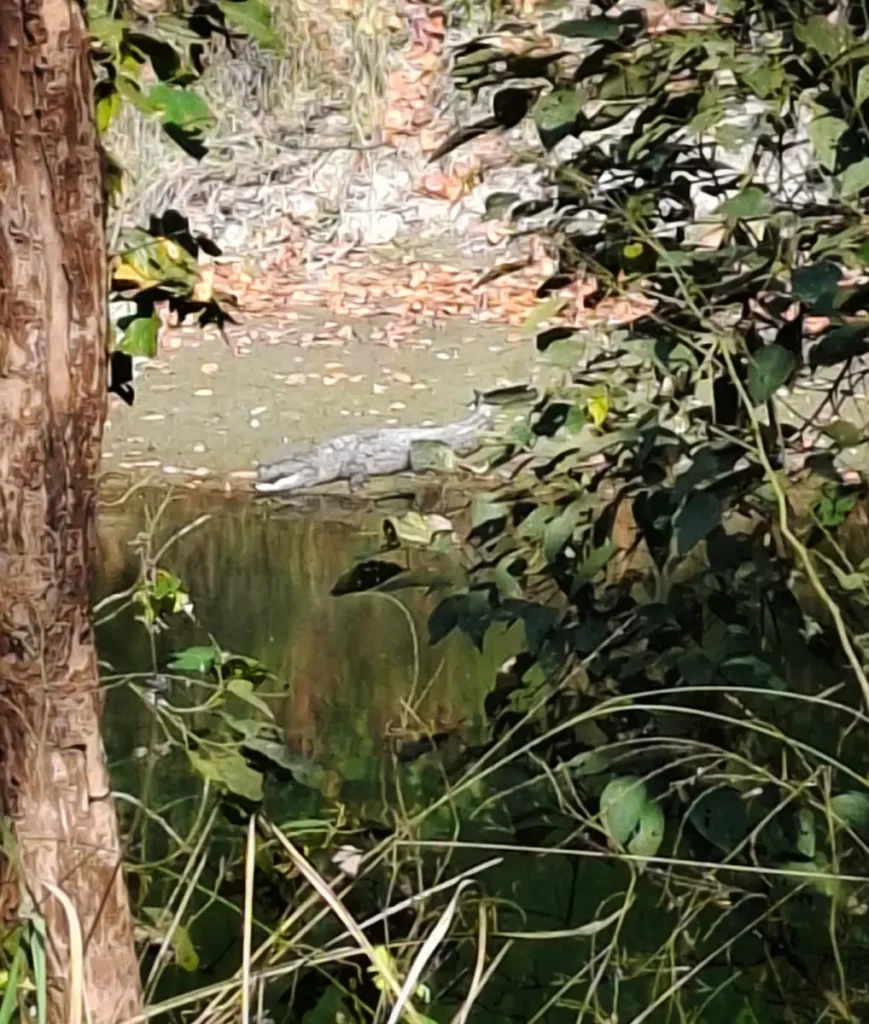
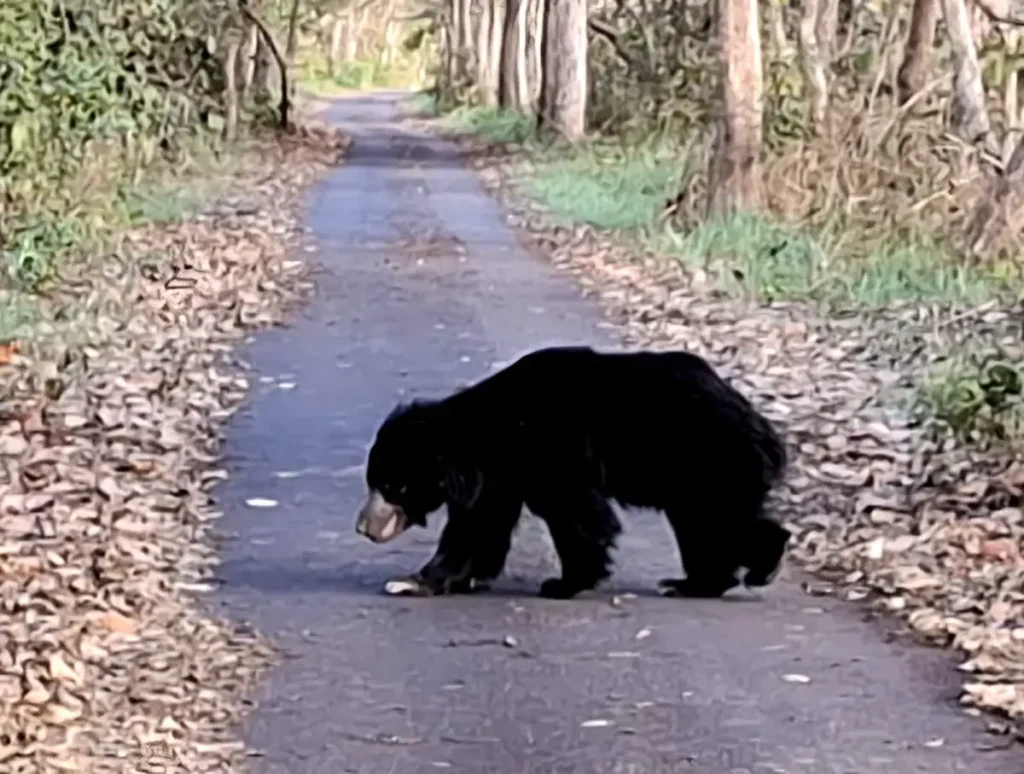
The icing on the cake was a sloth bear up close in the middle of the road. Even though four vehicles were piled up near it, its nonchalant behaviour continued, rummaging for grubs under the fallen leaves. It looks innocent but wild life wardens warn that it is even more dangerous than a tiger which will not mess with it. Another sighting was several crocodiles basking in the sun along the river bank.
An interesting man made structure was a canal flowing at 90 degrees above the rivulet. My father was among the first Indians to graduate in Civil Engineering in 1919 from Thomason College, now renamed IIT Roorkee. He had told us about the Upper and Lower Ganges Canals that originated at Haridwar and terminated right here in Kanpur. Among the engineering marvels of the time were the canals criss-crossing each other. Now we were seeing this for the first time.
Our biggest disappointment was the Chuka Lake or beach. There was a waterfront, but no beach! Yes there were hordes of visitors as it was on the edge of the forest. Since it was the day of Eid there were umpteen revelers, so there were more humans than wildlife. The Chuka Lake is a man made one because of the Sharda Sagar dam on the Sharda River, a tributary of the Ganga. It has its origin on the Indo Nepal border. In its upper reaches it is called the Mahakali River, just as the Ganga is known as the Bhagirathi or Alaknanda. Across the vast expanse of water one could see the Kumaon Hills in Uttarakhand.
There were two things that jarred on this trip. Firstly, on earlier ones to Corbett and Dudhwa we could take our vehicles right in to the forest, though accompanied by an authorized forest guide. Now private vehicles are no longer allowed in. We have to switch to safari vehicles, either Maruti Gypsies or Tata Xenons to enter the forest. The charges are Rs 5000/- for a 3½ hour round trip. The Gypsies had no rear doors so one had to climb into them, not easy for a 75 year old.
The other sore point was the ban on mobile phones as ordered by the Supreme Court. There were always additional charges on cameras but banning mobiles didn’t make sense. How could they disturb wildlife? The sfari vehicles have horns but they are not used in the forest areas. So too mobiles could be put on silent mode, but banning them altogether seemed excessive. After all we do like to share our experiences and images with others. In our case we were allowed to use just one mobile, my daughter’s. So we do have some pics to excite your imagination.
What really bugged us though was the sound from a Gurudwara about 2 kms away. The bhajans carried right in to the forest, beginning at 4 a.m. That seemed grossly unfair.Such hiccups apart there was something that did cause hiccups, the non-availability of tea enroute. Beer and cold drinks were available everywhere, but no tea, possibly because of the gas shortage. Fortunately we were able to get enough diesel to reach home safely.
We may not have seen the elusive tiger but we got our money’s worth with good clean air, the twittering of the birds and closeness to nature. We had time to stand beneath the boughs laden with mulberries and stare at the birds devouring them.
- Pics by Mariam Noronha
- Also read “The Mulberry Tree”


Leave a Reply